Calamansi vs Lime vs Key Lime: A Professional Kitchen's Guide
Three citruses, three very different jobs behind the line. A side-by-side comparison for chefs, bartenders, and operators deciding when to use which.
Every serious kitchen has a citrus decision hiding in plain sight: which acid lifts this dish, this drink, this dessert? For most American kitchens the default is Persian lime. But calamansi and Key lime each do things that Persian lime can't, and the difference between a good program and an ordinary one is often knowing when to reach for what.
This is the comparison we wish someone had given us when we started stocking calamansi commercially.
The Three Citruses, Briefly
Persian lime (Citrus latifolia)
The standard grocery-store lime. Large, seedless, moderately acidic, with a clean and recognizable citrus profile. Year-round supply, predictable pricing, easy to source. The workhorse.
Key lime (Citrus aurantifolia)
Smaller, rounder, seedier. Higher acid, more aromatic, slightly floral. The Florida standard, famously the base of Key lime pie. Short shelf life, inconsistent supply, more expensive.
Calamansi (Citrofortunella microcarpa)
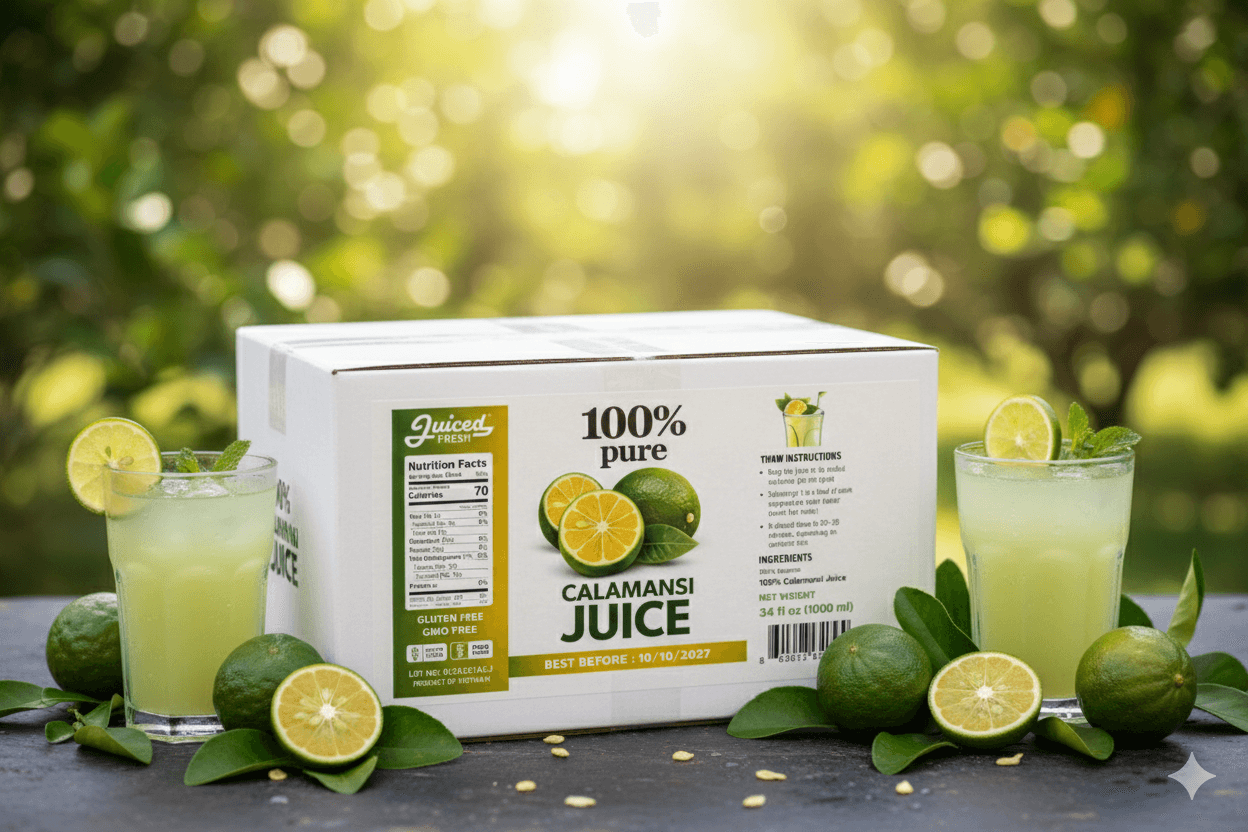
A natural hybrid of mandarin and kumquat, native to the Philippines. Small (cherry-sized), very seedy, extremely tart, with a rind that smells like orange blossom. Essentially unavailable fresh in the continental US; usually sourced as frozen juice.
Side-by-Side: Flavor and Acid
Persian lime delivers a clean, moderate acid with the grassy-green profile most people associate with "lime flavor." Brix is low; total acid runs around 4 to 5%.
Key lime is noticeably more acidic (5 to 6% total acid), with a brighter, more aromatic profile. The rind contains more aromatic oils than Persian lime, which is why Key lime pie tastes distinctively like Key lime and not like any other citrus.
Calamansi is the tartest of the three (6 to 7% total acid) and the most aromatically complex. The rind note reads like orange blossom rather than green citrus. The juice has a distinctive yellow-orange color that's neither lemon nor lime, with a floral finish that lingers past the acid.
A useful way to think about it: Persian lime is acid in its simplest form. Key lime is acid plus aromatics. Calamansi is acid plus aromatics plus a floral top-note that reads as Southeast Asian.
Where Each One Wins
Persian lime wins when the acid is a supporting player. Margaritas, guacamole, ceviche, Thai and Vietnamese dishes where lime is providing a base-layer brightness. If the dish has lots of other flavors pulling attention, Persian lime does its job and gets out of the way. It's also the right choice for high-volume operations where consistency and cost matter more than distinctive character.
Key lime wins when aromatic complexity is part of the signature. Key lime pie, of course. Key lime Gimlets, Key lime sorbet, Key lime butter for fish. Any preparation where you want citrus to be a visible, distinctive character. The shorter shelf life and higher cost are justified by the flavor impact.
Calamansi wins when you want citrus to be the signature. Calamansi sours, calamansi curd, Filipino kinilaw, calamansi-forward cocktails in tiki and craft bar programs. It's also the acid of choice for non-alcoholic drinks where you need complexity to carry the drink without booze. And it's the correct citrus for any Filipino menu item, where substitution with lime reads as inauthentic.
The Commercial Buyer's Math
For high-volume operations, the unit economics often determine the choice.
Persian lime at wholesale runs $0.20 to $0.35 per lime, yielding roughly 1 oz of juice. That's $0.30 per oz of juice, shrinkable further with hand-press efficiency.
Key lime is typically $0.60 to $1.00 per lime at wholesale, and each lime yields only about 0.5 oz. That's $1.80 to $2.00 per oz of juice, about 6x the cost of Persian.
Calamansi fresh is nearly impossible to source commercially in the US. Frozen pure calamansi juice (what we supply) runs about $12 to $18 per kilogram wholesale, which works out to roughly $0.40 to $0.60 per oz of juice, depending on case volume. So calamansi is more expensive than Persian lime but significantly cheaper than Key lime, with arguably more flavor impact than either.
Substitution Rules
When substitution makes sense:
- Persian for Key in a pinch, if rind aromatics aren't the feature. Squeeze in extra juice and add a small amount of grated lemon or lime zest for aromatic lift.
- Calamansi for Key in a recipe where you want tropical-Southeast-Asian character. Use 0.75 the volume; calamansi is more acidic.
- Calamansi for lemon in many baking applications. Curds, glazes, and tarts benefit from calamansi's floral note. Use 1:1.
When substitution doesn't work:
- Never substitute Persian for Key in a recipe called "Key lime." The pie, the cocktail, the sorbet: they're named for the aromatic profile. Using Persian here is dishonest and customers taste it.
- Never substitute Persian for calamansi in a Filipino recipe. Kinilaw, calamansi juice service, and calamansi sawsawan depend on calamansi's specific profile. Persian lime reads as generic.
Running All Three on the Same Line
Upscale craft programs often run all three citruses with different jobs:
- Persian lime as the base house citrus (cocktails, prep acid, daily mis en place)
- Key lime as a featured seasonal ingredient (pie, summer menu items, specialty cocktails)
- Calamansi as a signature differentiator (signature cocktail, dessert tart, non-alcoholic menu anchor)
This approach uses each citrus where it excels and positions your menu with a layer of complexity a single-lime program can't hit.
Supply Reality
Persian lime is everywhere and cheap. Key lime is seasonal and increasingly expensive as Florida production has declined. Calamansi is hard to get fresh in any quantity in the US, but reliable as frozen pure juice with no added water, sugar, or apple concentrate. We ship flash-frozen pure calamansi juice year-round from our Austin warehouse, with 24-month shelf life.
For operators building serious citrus programs, the frozen calamansi supply chain changes the math: you get the most distinctive citrus on your menu at a price that makes it accessible as a daily ingredient rather than a once-in-a-while feature.
FAQ
Can I use calamansi 1:1 for Persian lime?
You can, but the drink or dish will read as noticeably different: tarter, more floral, more complex. Many bartenders start at 0.75 the volume when substituting, then dial up to taste.
Does frozen calamansi juice taste different from fresh-squeezed?
In blind tests, trained palates can detect a small difference in the top-notes (the most volatile aromatic compounds). Customers almost never can. The flash-freeze process preserves 95%+ of the flavor profile of fresh-squeezed.
Why is Key lime so expensive now?
Citrus greening disease has devastated Florida production since the mid-2000s. Key lime acreage is a fraction of what it was, and imported Key lime from Mexico is more variable in quality. Expect prices to continue climbing.
What if I want all three on my menu without triple the sourcing headache?
Frozen calamansi is low-maintenance (12+ month shelf life). Key lime you source in season (winter-spring) and batch preserve as syrups and curds. Persian lime is weekly delivery. It's actually not much more work than running just Persian.
Published by Juiced Fresh.
Notes from the warehouse, the farm, and the bars we supply. See all Field Notes