Chapter
I
What is sugarcane?
Sugarcane (Saccharum officinarum) is a giant tropical grass domesticated somewhere in New Guinea roughly 8,000 years ago. From there it spread west through the Austronesian migrations, anchoring in Southeast Asia and India by 500 BCE, reaching Persia by 500 CE, and arriving in the Americas via Spanish and Portuguese colonization in the 15th century. It is, by a considerable margin, the most-cultivated crop by weight in human history.
Roughly 80% of the world's sugar comes from sugarcane today. But the sugar is only the after-effect of what the plant actually is: a stalk of freshly pressed cane yields a pale, honeyed, faintly grassy juice that tastes nothing like refined crystal. The refining process strips away everything except sucrose. The minerals, the polyphenols, the aromatic compounds, the color.
The plant grows as tall fibrous stalks. Anywhere from three to fifteen feet. Filled with a sweet sap stored in long parenchyma cells. When crushed between rollers, those cells release their juice. The remaining fibrous pulp is called bagasse, and it's used as fuel, animal feed, or paper pulp. Almost nothing of the cane plant is wasted.
Quick facts
- Sugarcane is a grass, not a tree. Closest crop cousin: corn.
- One 40–50 cm stalk yields 8–12 oz of fresh juice at 70%+ extraction.
- Sugar content (Brix) typically ranges 18–22° in commercial juicing varieties.
- Juice oxidizes within 15–30 minutes. Press to order whenever possible.
- Cane plants reproduce from stalk cuttings, called setts. Not from seeds.
Chapter
II
Where it grows.
Sugarcane is a tropical and subtropical crop. It needs warmth, water, and time. Nine to twelve months from planting to first harvest, and a narrow climate window to do it well.
The world's top sugarcane producers by volume are Brazil, India, China, Thailand, Pakistan, and Mexico. Together they grow roughly 80% of the global crop. Almost all of it goes to sugar refining, ethanol, and bagasse-derived energy. A smaller but meaningful share. Concentrated in Vietnam, the Philippines, and parts of India. Is grown specifically for juicing.
For juicing-grade cane, three growing conditions matter: consistent rainfall (60–80 inches annually), warm temperatures (20–30°C through the growing season), and rich alluvial soil. The varieties bred for sugar refining optimize for sugar recovery at industrial mill scale. The varieties bred for juicing optimize for taste, fiber ratio, and juice yield at the press.
Our origin
Bến Tre, Mekong Delta, Vietnam.
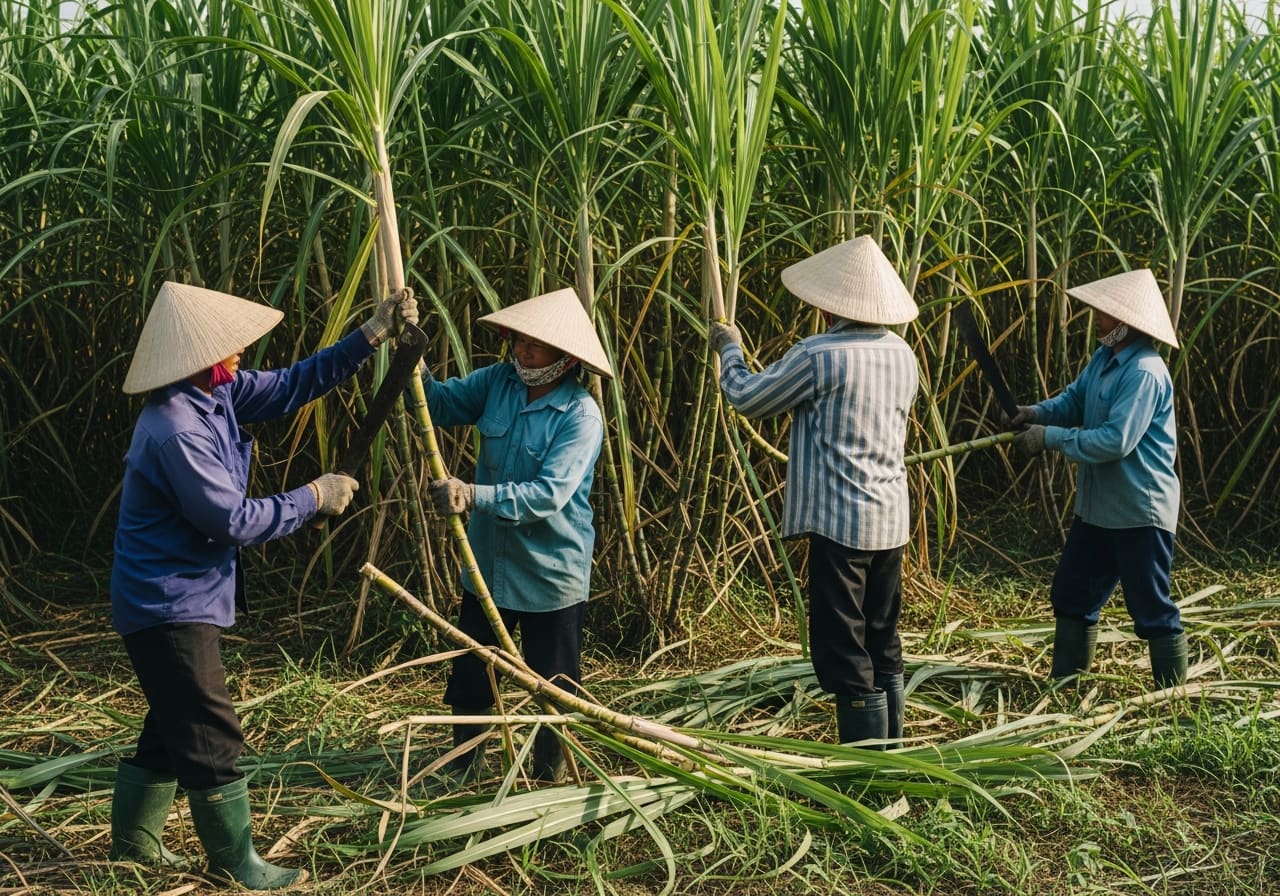
We source Vietnamese Yellow cane from eight family farms in Bến Tre and Long An provinces, at the mouth of the Mekong Delta. The region's alluvial floodplain soil, consistent monsoon rainfall, and year-round warmth make it one of Southeast Asia's premier juicing-cane regions. Harvest runs year-round with peak sucrose windows in October and April.
Chapter
III
Life cycle.
Sugarcane is propagated from stalk cuttings. Setts. Laid horizontally in trenches. Buds at the nodes sprout new roots and shoots. In the first 90 days, the plant enters tillering: new shoots multiply from the base, each becoming a stalk in the eventual harvest. By month four, stalk elongation begins in earnest. By month nine to twelve, the cane is at peak sucrose and ready to cut.
After harvest, the cane isn't replanted. The stump regrows. This is the ratoon crop. A single planting typically yields 2–4 ratoon cycles before the field is replanted. Ratoons grow faster than the original plant (they already have root systems) but yield slightly less each cycle.
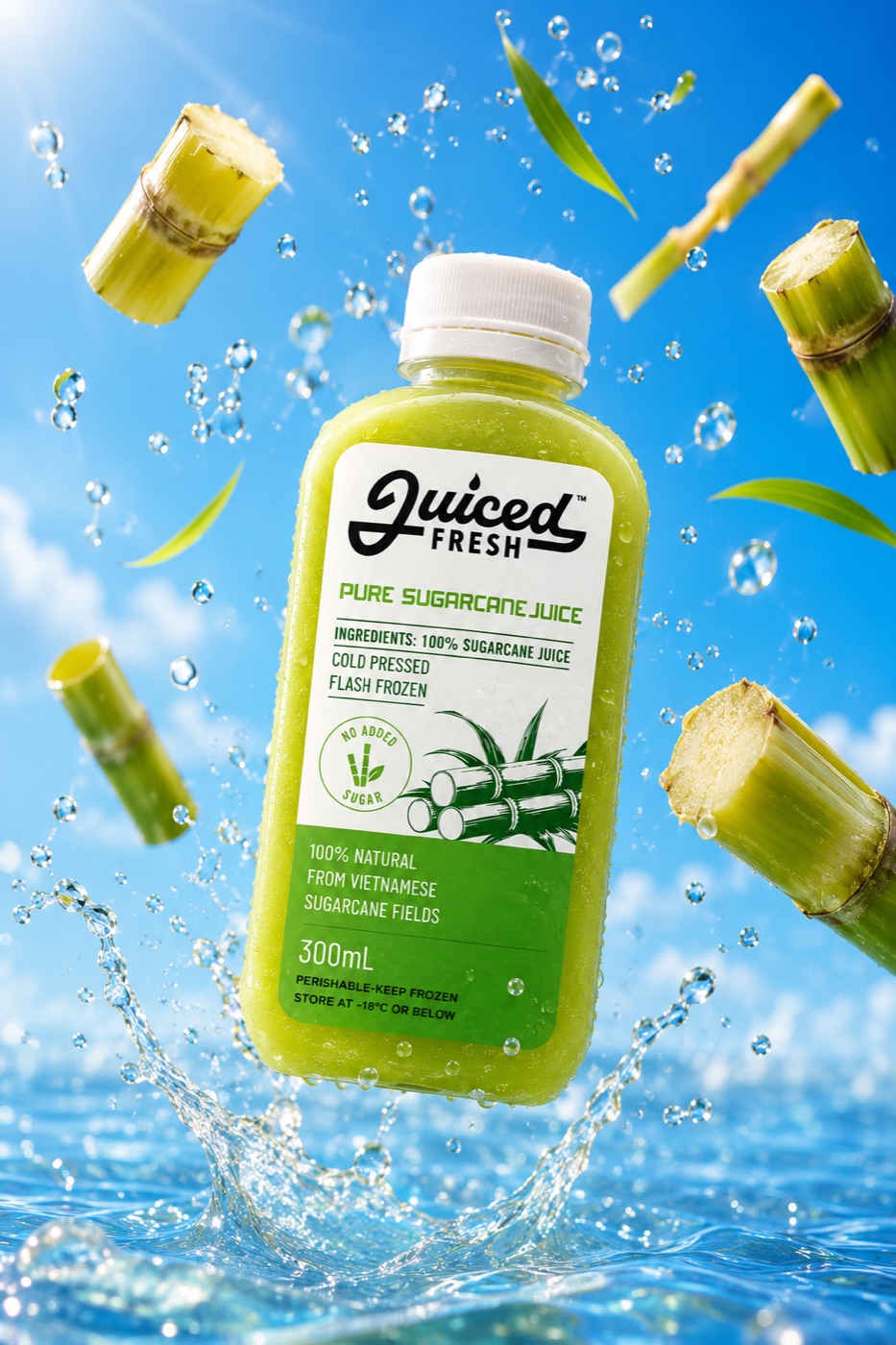
Harvest timing is everything. Cane cut before peak Brix yields less sugar; cane cut too late starts to decline. Traditional farmers read the weather, moon cycle, and the stalk itself. Dry papery leaves on the top third, a deep yellow-green rind, a slightly shriveled node near the base. For our farmers in Bến Tre, harvest happens at sunrise. Within four hours the stalks are trimmed, washed, and flash-frozen at −35°C, locking the juice at peak before oxidation can set in.
Chapter
IV
Varieties that matter.
There are hundreds of sugarcane cultivars. For commercial juicing, five matter. They differ in sugar content, fiber ratio, flavor, and ideal use. And picking the wrong one will show up on the palate.
Most cane grown in the US is CP-series hybrid, bred for Florida and Louisiana sugar factories. It's a sugar-recovery variety, optimized for a mill, not a juicer. For bar and juice-bar service, you want Vietnamese Yellow or a comparable Asian juicing cultivar. Here's the comparison operators actually run into.
| Variety | Region | Brix | Fiber | Flavor | Best for |
|---|---|---|---|---|---|
| Vietnamese Yellow (ROC16) | Mekong Delta, Vietnam | 18–22° | Medium | Honeyed, grassy finish | Juice bars, cocktails, rhum agricole |
| CO 419 | India, Pakistan | 17–21° | Medium-high | Classic sweet, mineral-forward | Ganne ka ras, traditional street pressing |
| Purple Caribbean | Caribbean, Louisiana | 16–19° | High | Earthier, less clean | Specialty cocktails, visual merchandising |
| Noble cane | New Guinea, heirloom | 20–24° | Low | Most complex, nuanced | Ultra-premium spirits, collectors |
| CP-series hybrids | Florida, Louisiana | 15–18° | High | Sugar-dense, grassy | Refining, ethanol, biomass |
Notes on the five varieties:
- Vietnamese Yellow (ROC16): Our house variety. The cleanest, most versatile profile for commercial juicing.
- CO 419: The workhorse variety across South Asia. Exceptional sugar recovery, slightly fibrous.
- Purple Caribbean: Short-season, dramatic purple rind. Lower juice yield but photogenic on a menu.
- Noble cane: The ancestor. Highest sugar, most fragile. Rarely commercial. Treasured by distillers.
- CP-series hybrids: Bred for sugar factories, not juicing. Lower yield per stalk, higher bagasse output.
Chapter
V
Global drink traditions.
Sugarcane isn't a novel ingredient in world cuisine. It's a load-bearing one. Six continents have indigenous cane-drink traditions, each with its own preparation, context, and cultural weight. Here are the ones operators in American foodservice most often draw from.
India
Ganne ka ras
/gaa-neh kaa raas/
Pressed on sidewalk carts from Delhi to Chennai, served over crushed ice with a squeeze of lime, knob of ginger, and a pinch of rock salt. A beloved summer ritual across the subcontinent, also essential during Ramadan and cultural festivals.
Vietnam
Nước mía
/n-oo-uk mee-uh/
The Vietnamese street drink. Cane crushed through a three-roller press with a whole kumquat. Skin, pith, and all. For a bright citrus lift. A cornerstone of banh mi shops, pho restaurants, and sidewalk refreshment culture from Hanoi to Saigon.
Mexico
Caldo de caña
/kal-do deh kan-yah/
Sold at aguas frescas stands and festival markets, often alongside tejuino and pulque. Unadorned or brightened with lime. A working-person's refreshment in agricultural regions, particularly Veracruz, Morelos, and Michoacán.
Cuba & Caribbean
Guarapo
/gwah-rah-poh/
The corner-stand drink of Havana and Miami's Calle Ocho. Pure pressed cane, served over ice. In the French Caribbean it becomes the base for Ti' Punch. The islands' defining cocktail ritual: rhum agricole, a squeeze of lime, a pour of cane syrup, one rock.
Brazil
Caldo de cana · Garapa
/kal-doh deh can-ah · gah-rah-pah/
Pressed at roadside botecos and paired with pastel, a deep-fried pastry. Brazil is the world's largest sugarcane producer. The drink is as common at a bus station as it is at a beachside resort. The fermented version becomes cachaça, the spirit in a caipirinha.
Egypt
'Aseer ʾasab
/ah-seer ah-sab/
Ancient Egypt was one of the earliest cane-growing civilizations. Modern Cairo has corner shops pressing cane to order, served in plastic cups with a light dusting of lemon. A continuous 3,000-year-old drinking tradition.
In every case, the operating principle is the same: fresh-pressed cane, consumed near-instantly, often with one acid or aromatic addition. That's the playbook American juice bars and cocktail programs are re-learning.
Chapter
VI
Nutrition & health.
Fresh sugarcane juice retains what refining strips away. It's still a sugar. But meaningfully different from table sugar in nutritional profile and glycemic impact.
The nutrient profile below is approximate per 1 cup (240 ml) of fresh-pressed sugarcane juice. Exact numbers vary with variety, ripeness, and juicer extraction rate. Daily Value (DV) is shown against a 2,000-calorie reference diet.
| Nutrient | Amount | % DV |
|---|---|---|
| Calories | ~180 kcal | - |
| Carbohydrates | ~45 g | ~16% |
| Sugars (sucrose-dominant) | ~43 g | - |
| Fiber (trace from pulp) | ~0.3 g | ~1% |
| Protein | ~0.2 g | <1% |
| Fat | 0 g | 0% |
| Potassium | ~150 mg | ~3% |
| Calcium | ~18 mg | ~2% |
| Iron | ~0.7 mg | ~4% |
| Magnesium | ~10 mg | ~3% |
Nutrition and menu positioning
Sustained natural energy
Carbohydrate-dominant but with naturally occurring minerals that support carbohydrate metabolism. Unlike refined sugar, the sucrose arrives alongside small amounts of iron, magnesium, and potassium.
Hydration with electrolytes
~75% water by weight with a trace electrolyte profile that makes it a reasonable post-exercise choice. Traditional medicine across South and Southeast Asia has prescribed it for heat exhaustion for centuries.
Polyphenols preserved
Refining strips phenolic compounds out of cane. Fresh pressed juice keeps them, delivering modest antioxidant activity that table sugar simply doesn't have.
Lower glycemic than refined sugar
Glycemic index of ~43, versus ~65 for white sugar. Still a sugar, still raises blood glucose. But more slowly, especially when consumed with food.
Trace minerals retained
Small amounts of calcium, iron, potassium, and magnesium survive the pressing process. Meaningful compared to refined sugar's zero, but not meaningful in large enough quantity to supplement a diet.
Traditional digestive support
Ayurvedic and traditional Chinese medicine have used sugarcane juice for digestion and liver function for millennia. Modern research is limited but the cultural track record is long.
A note on blood glucose: sugarcane juice is still a sugar-containing beverage. Portion size, menu context, and customer-specific medical guidance matter more than comparing one sweetener claim against another. Do not market it as suitable for diabetes management.
Chapter
VII
Sugarcane vs other sweeteners.
Fresh pressed cane juice is a whole-plant sweetener. Table sugar is a refined molecule. Those are categorically different things, but they get used interchangeably in marketing claims. Here's the straight comparison most kitchen and bar teams actually care about.
| Sweetener | Glycemic Index | Calories | Profile | Processing |
|---|---|---|---|---|
| Fresh sugarcane juice | ~43 | ~40 kcal / oz | Sucrose + trace minerals & polyphenols | Pressed, unrefined |
| White table sugar | ~65 | ~46 kcal / tbsp | 99.9% sucrose, no other nutrients | Heavily refined, crystallized |
| High-fructose corn syrup | ~68 | ~53 kcal / tbsp | Fructose + glucose blend | Enzymatic corn conversion |
| Honey | ~58 | ~64 kcal / tbsp | Fructose-forward, with enzymes | Raw to ultra-filtered varies |
| Agave syrup | ~15 | ~60 kcal / tbsp | Very high fructose (~70–90%) | Enzymatically converted |
| Maple syrup | ~54 | ~52 kcal / tbsp | Sucrose + minerals + phenolics | Boiled sap, minimal refining |
| Coconut sugar | ~54 | ~45 kcal / tbsp | Sucrose + inulin + trace minerals | Evaporated palm sap |
The short version: fresh pressed cane sits in the middle of the GI spectrum. Lower than refined sugars and HFCS, higher than agave (which is very high in fructose, which carries its own metabolic concerns). What distinguishes cane juice from most sweeteners on the list is that it's minimally processed and arrives as a single ingredient with its nutrient matrix intact.
Related deep dives:
Chapter
VIII
Fresh vs frozen.
The short answer: frozen for nearly every commercial use. Fresh for visual merchandising, same-day events, and specialty retail. Here's the operator's version of why.
Fresh
- 7–10 day refrigerated shelf life
- Maximum crunch and visual impact on display
- Great for same-day events and farmers market vendors
- Oxidizes faster once cut or peeled
- Needs weekly reorder discipline
Frozen
Recommended- 12-month frozen shelf life
- Consistent 18–22° Brix year-round, no seasonal swings
- Actually presses with higher juice yield (cell walls pre-broken)
- USDA-compliant, buds removed at origin
- Order a pallet, run through a quarter
Chapter
IX
How to juice sugarcane.
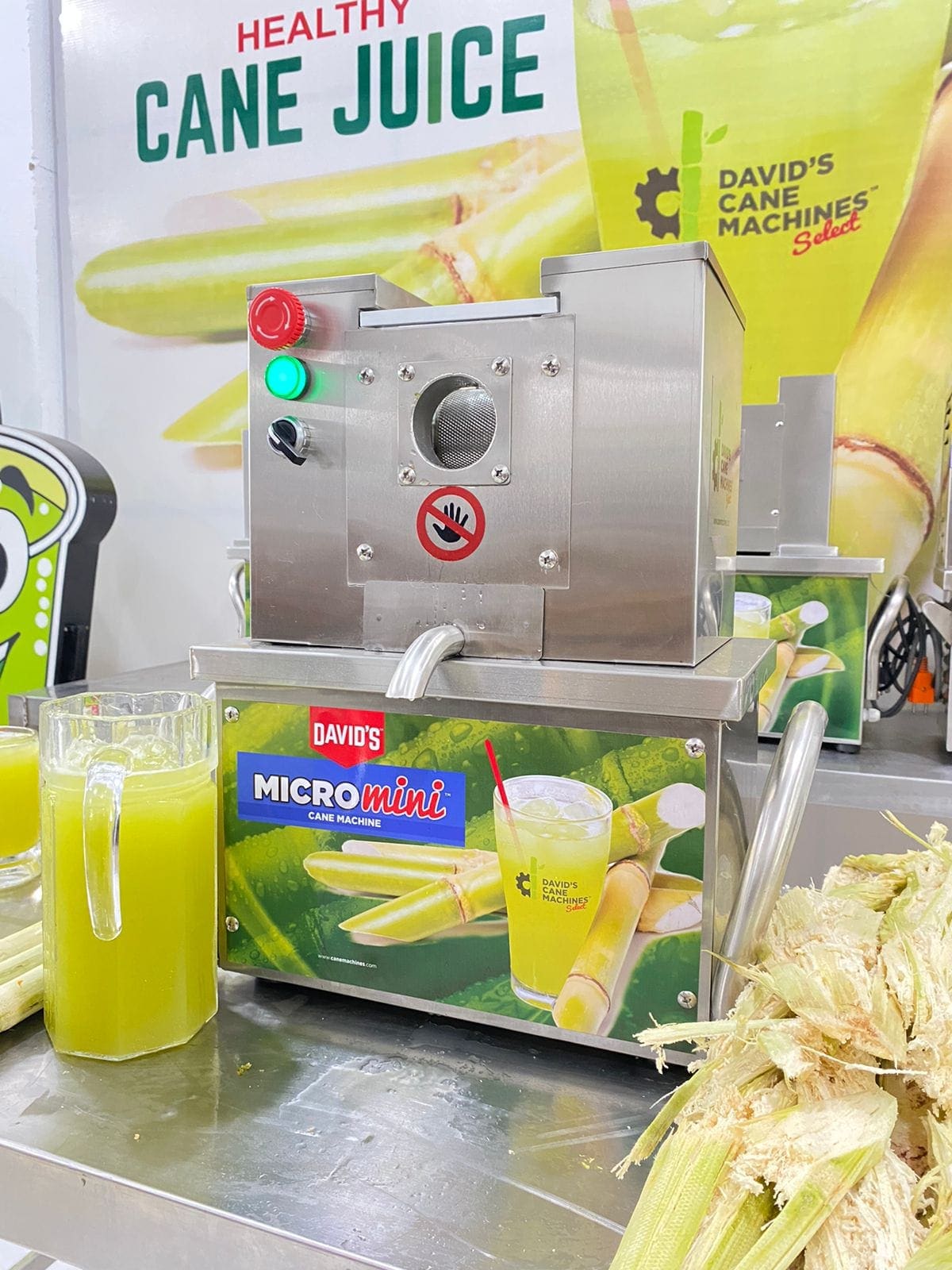
You need a cane-specific roller press. Centrifugal and masticating juicers don't work. They shred the stalk rather than press it, which leaves fiber in the glass and drops juice yield to 40–50%. A proper cane press rolls the stalk through one or more sets of grooved rollers, squeezing the juice out cleanly while keeping bagasse separate.
Equipment tiers
| Tier | Price | Output | Right for |
|---|---|---|---|
| Manual hand press | $80–200 | Slow · ~8–16 oz per stalk | Demos, prep testing |
| Electric home juicer | $300–800 | Moderate · one stalk per minute | Small cafés, home enthusiasts |
| David's Cane Machine | Available via Juiced Fresh | 1 L per minute · 70%+ extraction | Juice bars, restaurants, bars |
| Commercial triple-roller | $2,000–4,000 | High · continuous feed | High-volume juice bars, festivals |
| Industrial mill | $5,000+ | Pallet-level throughput | Distilleries, large operators |
For almost all commercial juice-bar and restaurant applications, David's Cane Machine is the right press. 800W motor, 1 L per minute output, 70%+ extraction rate, and a 38 kg frame that fits under most bar counters. We supply it directly.
Pressing technique
- 01Thaw frozen stalks 24–48 hours in the refrigerator.
- 02Cut to machine-appropriate lengths (typically 12–18 inches).
- 03Pass each piece through the press 2–3 times for maximum extraction.
- 04Strain juice through a fine mesh to catch fiber fragments.
- 05Serve immediately over ice, with a squeeze of lime or kumquat if you want the classic lift.
See the complete step-by-step juicing guide · David's Cane Machine details
Chapter
X
Pro tips & common mistakes.
After supplying 500+ juice bars, cocktail programs, and distilleries, we've seen what separates the operators who make money from cane from the ones who don't. Here's the operator shorthand.
The eight tips
Thaw frozen stalks 24–48 hours in the fridge. Never at room temp or in warm water. Slow thaw preserves cell structure and juice yield.
Run each stalk through the press 2–3 times. Second and third passes recover 15–20% more juice than a single pass.
Add a squeeze of lime and a knob of ginger at service. The acid lift balances the pure sweetness and is the house standard across Vietnam, India, and the Caribbean.
Frozen stalks actually press better than fresh. Cell walls are already broken down by the freeze, so extraction is higher.
Keep a pallet of frozen backup. 12-month shelf life means you can't get caught short during a promotional spike.
Press to order whenever possible. Fresh cane juice oxidizes within 15–30 minutes. Batch-pressing for a full shift loses color, aroma, and brightness.
Watch the pulp. Fine-mesh strain before serving. Fibrous bits in the glass kill the drink's premium feel.
Don't blend cane juice with ice in a centrifugal blender. It aerates and oxidizes. Shake in a tin, pour over crushed ice.
Common mistakes, flagged
Thawing in warm water
Fast thaw ruptures cell structure unevenly and reduces yield. Refrigerator thaw for 24–48 hours is the only acceptable method for commercial operators.
Pressing pre-oxidized stalks
If stalks are discolored (brown, gray, or yellow-black at the cut end), they've oxidized. Juice will taste off. Trim the affected sections or reject the case.
Over-pressing
After 3 passes, you're extracting bagasse-bitter compounds, not juice. More passes = dirtier juice, not higher yield.
Serving oxidized juice
Once pressed, juice must be served within 30 minutes or refrigerated in an airtight container for no more than 24 hours. Oxidized juice tastes sour and flat.
Using a non-cane juicer
Centrifugal and masticating home juicers shred cane but don't press it. Fiber ends up in the glass and juice yield is 40–50% of a proper cane press.
Chapter
XI
Storage & handling.
Two temperature windows, two procedures. Mix them up and you lose product.
Fresh stalks
- Refrigerate at 35–45°F (2–7°C).
- Keep in plastic wrap or a sealed container.
- Use within 7–10 days.
- Don't freeze fresh stalks at home. Texture suffers.
- Trim any brown or gray cut ends before pressing.
Frozen stalks
- Store at 0°F (−18°C) or below.
- 12-month shelf life frozen.
- Thaw in refrigerator, never at room temp.
- Use within 5–7 days after thawing.
- Never refreeze once thawed.
Pressed juice storage
- Frozen pressed juice: 24 months at 0°F or colder.
- Refrigerated pressed juice: 5–7 days in an airtight container.
- Room-temperature service: up to 30 minutes before quality loss.
- Vacuum-sealed juice: extends refrigerated window to 7–10 days.
Chapter
XII
Yield & economics.
Planning a purchase? These are the numbers we use when quoting customers. Based on a 12 oz serving at a $5 menu price. Adjust for your market.
| Order size | Servings | Est. revenue | Best for |
|---|---|---|---|
| 10 lb (¼ case) | 8–12 | $40–60 | Testing, small events |
| 22 lb case | 18–24 | $90–120 | Trial orders, cafés |
| 110 lb (5 cases) | 90–120 | $450–600 | Busy locations |
| 1,056 lb (pallet) | 850–1,150 | $4,250–5,750 | High-volume, chain ops |
| 20-ft container | 18,000+ | $90,000+ | Distributors, distilleries |
Margin math
Wholesale pricing typically lands well below small-quantity order cost per 12 oz serving. Menu pricing at $5–7 gives a strong gross margin, and pallet pricing drops per-serving cost by 10–20%, which is where the economics get seriously interesting for chain operators.
The variable cost side is largely labor and waste. Well-run operators keep waste under 5% by pressing to order and using peel-trim in syrups or compost. Poorly-run operators lose 15–20% to oxidized juice, forgotten thawed stalks, or over-pressing.
Chapter
XIII
Sugarcane for business.
Fresh pressed cane is growing fast as a category in American foodservice. It sits at the intersection of four rising trends. Clean-label ingredients, authentic diaspora cuisine, craft cocktail programs, and category-expansion juice bars. Here's where it fits by segment.
Juice bars
85%+ gross margin on fresh-pressed cane drinks. One of the best-margin menu items in the segment.
Learn moreRestaurants
Authentic ganne ka ras, nước mía, and guarapo service for Indian, Vietnamese, and Caribbean kitchens.
Learn moreCocktail bars
Fresh cane for mojitos, caipirinhas, Ti' Punch, and cane syrup. The ingredient cocktail programs are rediscovering.
Learn moreRum distilleries
Bulk pressed juice in drums and IBC totes for rhum agricole and cane-juice rum production.
Learn moreIce cream & dessert
Tropical fruit and cane syrup base for sorbets, panna cotta, and kulfi.
Learn moreEvent caterers
Pallet-level fresh cane for festivals, weddings, and high-volume one-day events.
Learn moreChapter
XIV
Common questions.
Fifteen questions we hear most often from operators and consumers evaluating cane as a menu item or a home beverage.
How much juice does one sugarcane stalk produce?+
A 40–50 cm (16–20 inch) stalk typically yields 8–12 oz (240–350 ml) of fresh juice at 70%+ extraction. Frozen stalks tend toward the higher end because cell walls are pre-broken by freezing.
What's the difference between fresh and frozen sugarcane?+
Fresh stalks last 7–10 days refrigerated and look more dramatic on display. Frozen stalks hold 12 months at 0°F, ship predictably, and actually press with higher juice yield. The vast majority of commercial operators run on frozen for menu consistency.
Do I need a special juicer for sugarcane?+
Yes. Sugarcane is too fibrous for centrifugal or masticating juicers. You need a cane-specific roller press. David's Cane Machine handles peeled or unpeeled stalks at 1 L per minute with 70%+ extraction. That's our recommended press for commercial use.
How long does fresh sugarcane juice last?+
Best within 15–30 minutes of pressing. Refrigerated in an airtight container, it holds 24–48 hours but darkens and loses brightness quickly. For service, press to order whenever possible.
Is sugarcane juice healthier than refined sugar?+
Nutritionally yes. Fresh juice retains polyphenols, trace minerals, and has a lower glycemic index (~43 vs ~65). But it's still a sugar. It's a better sweetener, not a health food.
What should customers managing blood sugar know?+
Sugarcane juice contains sugar and can affect blood glucose. Do not position it as suitable for diabetes management. Customers managing diabetes or blood glucose should follow guidance from their clinician.
What's the best sugarcane variety for juicing?+
Vietnamese Yellow (ROC16) is our house variety. 18–22° Brix, excellent juice yield, and a clean honeyed finish that works across cocktail, juice, and culinary applications. It's the variety we source from family farms in Bến Tre.
How do I thaw frozen sugarcane properly?+
Refrigerator only, 24–48 hours. Don't thaw at room temperature (bacterial risk) or in warm water (ruptures cell structure). Once thawed, press within 5–7 days.
Can I start a sugarcane juice business with small orders?+
Yes. Our 22 lb case is designed for that. Juice bars qualifying the product before committing to standing orders. Start with a case, prove the unit economics, scale to pallet.
Where does Vietnamese sugarcane come from?+
Our cane comes from eight family farms in Bến Tre and Long An provinces, in Vietnam's Mekong Delta. The region's alluvial soil and consistent tropical climate make it one of the best cane-growing areas in Southeast Asia.
What's the shelf life difference between fresh and frozen?+
Fresh: 7–10 days refrigerated. Frozen: 12 months at 0°F. Once thawed, frozen stalks behave like fresh. Use within 5–7 days.
Is sugarcane juice the same as cane syrup or molasses?+
No. Sugarcane juice is the raw pressed liquid. Cane syrup is juice reduced down to a thick pourable sweetener. Molasses is the dark by-product of refining table sugar. A different product entirely, with a different flavor.
Why is Vietnamese cane preferred over Caribbean or US-grown?+
Vietnamese Yellow runs higher Brix (18–22° vs 15–19°), has a cleaner flavor profile with less earthy grass notes, and better fiber-to-juice ratio for commercial pressing. US-grown cane is bred mostly for sugar refining, not for juicing.
Can I buy sugarcane juice in bulk for fermentation or distilling?+
Yes. We supply 100% pressed sugarcane juice in 55-gallon food-grade drums and 275-gallon IBC totes for distilleries, co-packers, and production kitchens. See our rum distillery page for specs and bulk pricing.
Is the product USDA-compliant and food-grade?+
Yes. Our frozen stalks have buds removed to meet USDA import requirements. Pressed juice ships in FDA-compliant food-grade containers with COAs on request. All product is held in Austin and shipped from a US entity, so customers have no customs or phyto exposure.
Chapter
XV
Glossary.
Ten terms that come up often when talking about sugarcane. Reference them as needed.
Brix (°)
A measure of sugar content by weight in a liquid. 18° Brix means 18% sugar. Cane juice typically falls between 15–22° Brix depending on variety and ripeness.
Bagasse
The fibrous residue left after cane is pressed. Used as fuel for sugar mills, as animal feed, and in paper manufacturing.
Rhum agricole
French Caribbean rum distilled from fresh cane juice rather than molasses. Defined by its grassy, vegetal profile. The reason French islands' rum tastes distinctly different from Caribbean English-heritage rum.
Ratoon
The regrowth from a cut stalk. A single sugarcane planting typically produces 2–4 ratoon crops before replanting is needed.
Noble cane
Saccharum officinarum in its heirloom form, originally domesticated in New Guinea. Highest sugar content, lowest fiber, but less disease-resistant than modern hybrids.
Tillering
The phase in a sugarcane plant's first 90 days where new shoots emerge from the base, multiplying the number of stalks the plant will produce.
Flash-freezing
Rapid freezing at −35°C or colder that minimizes ice-crystal formation and preserves the cell structure of the stalk, protecting juice yield and flavor.
Sett
The stalk cutting used to propagate sugarcane. Cane is planted from setts, not seeds, because setts produce faster, more predictable growth.
Cold chain
The temperature-controlled logistics system that keeps frozen product continuously at or below 0°F from origin to end user. Breaking the chain causes quality loss.
Cane syrup
Fresh sugarcane juice reduced by evaporation to a thick pourable sweetener, used in cocktails (Ti' Punch), pastry glazes, and Southern US cuisine.
Keep reading
Related guides and references.
The Juiced Fresh Sugarcane Guide