Chapter
I
The basics.
Sugarcane storage comes down to two temperature windows and three product formats. The temperature windows are refrigerated (35–45°F, for fresh stalks and pressed juice you'll use within a day) and frozen (0°F or colder, for stalks and juice that need to hold weeks or months). The three formats are fresh stalks, frozen stalks, and pressed juice.
Get those two windows right and rotate stock first-in-first-out. Most storage mistakes are variations on the same theme: someone left product in the wrong window for too long, or thawed it in the wrong place.
Quick facts
- Fresh stalks: 35–45°F, 7–10 days shelf life.
- Frozen stalks: 0°F or colder, 12 months shelf life.
- Pressed juice fresh: serve within 30 minutes of pressing.
- Pressed juice frozen: 18 months at 0°F.
- Never thaw at room temperature or in warm water.
Chapter
II
Fresh stalks.
Fresh sugarcane is alive, which is both the advantage and the constraint. It keeps its crunch and its display appeal, but the clock starts running the moment it's cut.
Temperature
35–45°F
Shelf life
7–10 days
- 01
Refrigerate at 35–45°F (2–7°C)
The standard produce-walk-in range. Too cold (below 32°F) causes chill damage; too warm accelerates oxidation and sugar fermentation. A dedicated shelf in the walk-in is ideal.
- 02
Keep airtight
Wrap in food-grade plastic film or store in a sealed container. Airflow around the cut ends accelerates browning and dehydration. Each exposed end loses moisture to the walk-in within hours.
- 03
Do not wash until pressing
Water on the outer rind creates a moist film that bacteria colonize quickly. Store dry and rinse under cool running water only in the moment before pressing.
- 04
Separate from ethylene producers
Apples, bananas, pears, avocados, and tomatoes off-gas ethylene, which speeds ripening and spoilage in nearby produce. Keep sugarcane in its own zone or shelf.
- 05
Use within 7–10 days
Fresh stalks stored correctly hold their juice quality for about a week and a half. After that, you'll see browning at the cut ends and the juice turns sour-sweet. Use within the window or transfer to freezing.
Chapter
III
Frozen stalks.
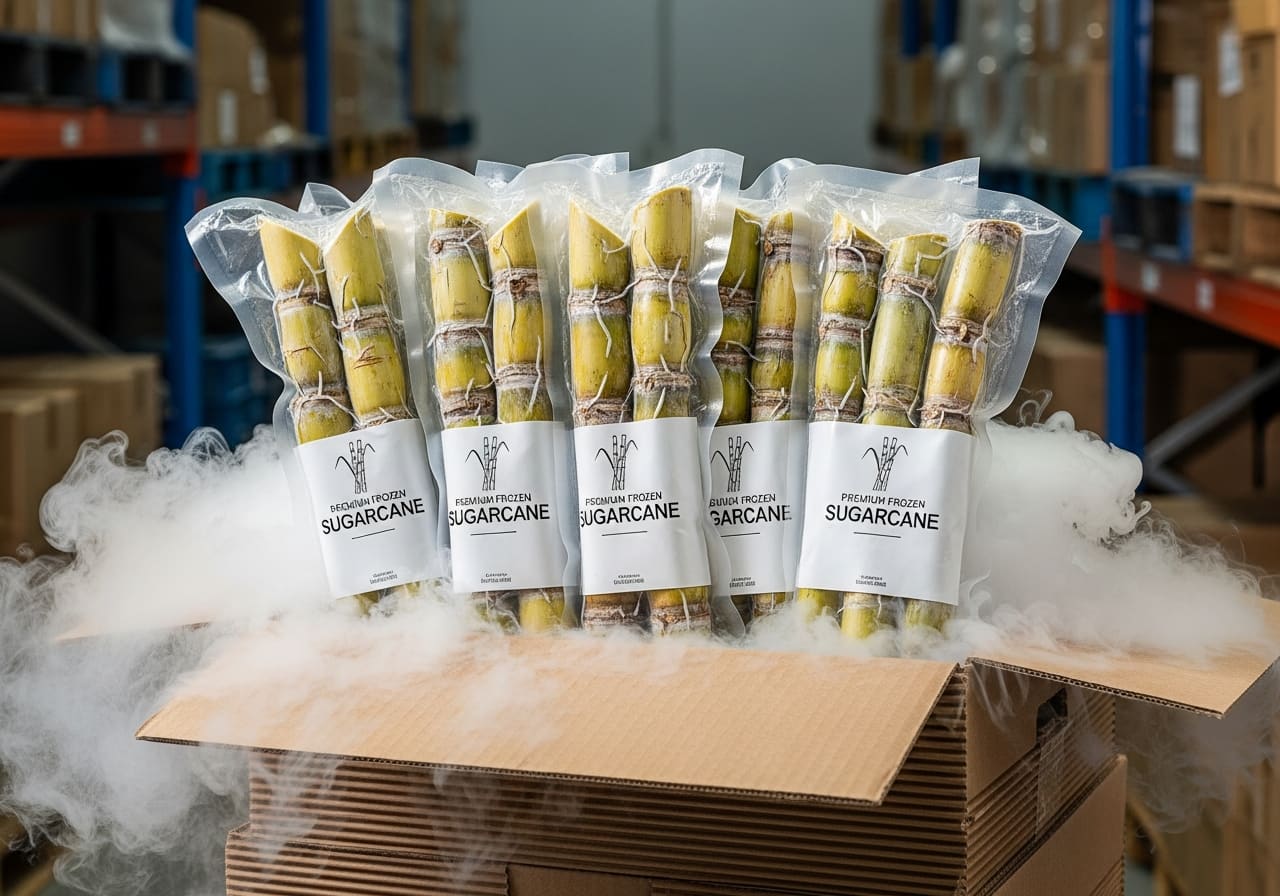
Frozen stalks are the commercial-operator default. 12-month shelf life means a pallet purchased in January can still be pressed in December with no quality loss. The flash-freeze process we use at origin preserves cell structure better than any home or commercial re-freeze you could attempt.
Temperature
0°F or below
Shelf life
12 months
- 01
Store at 0°F (−18°C) or colder
This is the USDA standard freeze point for commercial food service. Below 0°F, no enzymatic or microbial activity happens. Most commercial walk-in freezers run at −5°F to 0°F.
- 02
Keep in original packaging until ready
Our frozen cases ship in food-grade polyethylene liners inside waxed boxes. Leave them sealed until the day you plan to thaw. Repackaging introduces moisture and contamination risk.
- 03
12-month shelf life
Flash-frozen Vietnamese Yellow cane at −35°C, held at 0°F or colder, retains flavor and Brix for a full year. Rotate stock first-in-first-out. Label every case with a received-date and use-by date.
- 04
Never refreeze thawed stalks
Refreezing ruptures cell walls a second time. Juice yield drops 20–30%. Flavor goes flat. If you thawed more than you needed, press the excess, freeze the juice in portions.
- 05
5–7 days refrigerated after thaw
Once fully thawed, treat frozen stalks like fresh. Refrigerated at 35–45°F, they hold a week. Any longer and you lose the freshness advantage we locked in during flash-freezing.
Chapter
IV
Pressed juice.
Juice storage has a much tighter margin than stalk storage. Fresh-pressed juice oxidizes in minutes. Frozen juice is the commercial answer.
- 01
Fresh pressed: serve immediately
Cane juice oxidizes within 15–30 minutes of pressing. The color darkens, flavor dulls, polyphenols degrade. Press to order whenever possible. Every minute counts.
- 02
Refrigerated fresh juice: 24 hours max
In an airtight container at 35–40°F, pressed juice holds about a day. Beyond that, even if it's still safe to drink, the brightness is gone. Quality, not safety, is the limiting factor.
- 03
Frozen pressed juice: 24 months at 0°F
Our bottled and drum-format pressed juice is flash-frozen at the press house and holds 24 months at 0°F. Texture, color, and flavor all survive the freeze.
- 04
Once thawed: 5–7 days refrigerated
Thaw frozen juice in the refrigerator overnight (for smaller containers) or 24 hours (for 1 kg bags). Use within a week.
- 05
Vacuum-sealed extends the window
For pressed juice that needs to hold longer than 24 hours refrigerated, vacuum-seal in portioned bags. Removes air, slows oxidation, pushes the refrigerated window to 5–7 days.
For bar programs and distilleries sourcing pressed juice as an input, we ship frozen in 1 kg bags, 55-gallon drums, and 275-gallon IBC totes. Full flash-frozen provenance preserved through the supply chain. See drum and IBC formats.
Chapter
V
Thawing, format by format.
Refrigerator thaw is the only correct method. Plan ahead. A case of stalks needs 24–48 hours, and a drum needs nearly a week. Here's the table operators use for thaw scheduling.
| Format | Method | Time | Notes |
|---|---|---|---|
| 22 lb case of stalks | Refrigerator, sealed | 24–48 hours | Standard. Plan thaw timing around your service calendar. |
| 1 kg bag of pressed juice | Refrigerator | 8–12 hours overnight | Can also be partially submerged in a cold-water bath (still in sealed bag) for 2–3 hours if needed faster. |
| 55-gallon drum of juice | Walk-in refrigerator | 4–7 days | Plan a week ahead for mash or service windows. Drums are too large to rush. |
| 275-gallon IBC tote | Temperature-controlled thaw room | 7–10 days | Distillery-scale thaws need dedicated logistics. Message us for thaw-schedule guidance. |
Chapter
VI
Storage summary.
The whole thing in one table. Keep this on your walk-in door if you supervise a kitchen.
| Format | Temperature | Shelf life | Best for |
|---|---|---|---|
| Fresh stalks | 35–45°F | 7–10 days | Immediate use, same-day events, display merchandising |
| Frozen stalks | 0°F or below | 12 months | Standing commercial orders, pallet stock |
| Thawed stalks | 35–45°F | 5–7 days | Short-window service after freezer pull |
| Fresh pressed juice | Serve immediately | 15–30 min before oxidation | Press-to-order juice bars |
| Refrigerated pressed juice | 35–40°F, airtight | 24 hours | Next-service prep, cocktail mise en place |
| Frozen pressed juice | 0°F or below | 24 months | Bar programs, distillery fermentation input |
Chapter
VII
Common mistakes to avoid.
Six mistakes we see repeatedly. Each with its root cause and the specific fix. If you're losing product to spoilage, it's almost always one of these.
Mistake
Home-freezing fresh stalks
Why it's bad
Home freezers run at ~5–10°F. Not cold enough to preserve cell structure. Flash-freezing at −35°C is what we do at origin because temperature-gradient matters. Home freezing ruptures cells unevenly, drops juice yield 30%+, and makes pressing harder.
Fix
Order our professionally flash-frozen stalks. If you must freeze fresh cane, press the juice first and freeze the juice. That survives home freezing better than whole stalks.
Mistake
Thawing at room temperature or in warm water
Why it's bad
Both methods put cane into the bacterial danger zone (40–140°F) for hours while the center is still frozen. Warm-water thaws also rupture cell walls unevenly.
Fix
Refrigerator thaw only. 24–48 hours for a case of stalks, 8–12 hours for small juice bags. Plan your thaw schedule around service.
Mistake
Storing near ethylene producers
Why it's bad
Apples, bananas, tomatoes, pears, and avocados emit ethylene gas that accelerates ripening and spoilage in nearby produce. Cane absorbs it.
Fix
Give cane its own walk-in zone or shelf. If space is tight, store in a sealed container that blocks ethylene exposure.
Mistake
Refreezing thawed product
Why it's bad
Second-cycle freezing does twice the cell-wall damage. Juice yield crashes, flavor flattens, texture turns mushy. Food-safety risk too. Bacteria that survived the first thaw multiply.
Fix
Thaw only what you'll use. If you over-thawed, press the excess and freeze the juice in portion-sized bags or ice-cube trays.
Mistake
Leaving pressed juice at room temperature
Why it's bad
Fresh cane juice is one of the most rapidly-oxidizing fresh juices you can press. Room-temperature exposure for even 30 minutes causes visible darkening and flavor flattening.
Fix
Press to order. If you must hold, refrigerate immediately in an airtight container, use within 24 hours.
Mistake
No FIFO rotation in the walk-in
Why it's bad
Stalks get lost behind fresher arrivals. Boxes that should have been used in month 3 of their shelf life end up pressed at month 10, with degraded flavor and yield.
Fix
Label every case with received date. Use-by sticker. Rotate first-in-first-out. Audit once a month.
Chapter
VIII
Signs of spoilage.
Five things to look for before pressing any stalk. One clear sign is enough to discard.
Soft, mushy, or spongy texture
Healthy stalks feel firm and dense. Give a little to gentle squeeze but don't deform. Soft or squishy means cell structure has broken down. Don't press.
Mold (white, green, gray, or black)
Any visible mold means the stalk is compromised. Mold growing on the surface often has hyphae extending into the flesh. Discard the entire stalk, not just the spotted section.
Sour or fermented smell
Fresh cane smells faintly grassy, slightly honeyed. A sour or alcoholic-fermented smell means yeast activity. The sugars are converting. Not safe to serve.
Dark discoloration in the flesh
Trim the cut end; the inside flesh should be pale yellow-green to cream. Gray, brown, or black flesh means oxidation has penetrated. Trim until you reach clean tissue or discard.
Slimy surface
Bacterial biofilm. Don't try to wash it off. The surface texture tells you what's happening inside. Discard.
When in doubt, discard. Food safety margin is cheaper than a reputation or health incident. If something looks or smells off, trust the instinct.
Chapter
IX
Commercial operations checklist.
Six items that distinguish a well-run commercial sugarcane operation from one that's losing product. Adopt all six. They compound.
01
Dedicated freezer space
Plan freezer real estate before you order a pallet. A 48-case pallet of frozen stalks takes roughly 40 cubic feet of freezer space. Confirm capacity before scheduling delivery.
02
Received-date labels on every case
Label each case with the received date and use-by date. FIFO rotation is how professional kitchens manage a freezer. Audit stock monthly so nothing ages out past the 12-month window.
03
Thaw scheduling on a calendar
A 22 lb case needs 24–48 hours in the fridge to thaw. Build thaw timing into your weekly order-and-production calendar. Thaw on Monday to press Tuesday and Wednesday.
04
Temperature logs
For HACCP compliance, keep a daily log of walk-in and freezer temperatures. We provide lot-level COAs and shipping temperature logs with every delivery for your records.
05
Juice-batch documentation
If you press daily for the next service and refrigerate overnight, document the press date and use-by date on every container. 24-hour window is real. Past it, quality visibly drops.
06
Emergency failover stock
Keep one extra pallet as safety stock. Cold-chain shipping delays happen. Freezer backup means a missed delivery doesn't become a missed service window.
Chapter
X
Common questions.
Can I freeze fresh sugarcane myself?+
It works for the juice but not for whole stalks. Home freezers run at 5–10°F, compared to our −35°C flash-freeze process. Home freezing ruptures cell walls unevenly, which drops juice yield significantly when you eventually press. If you need frozen stalks, order our professionally flash-frozen product. If you have excess fresh stalks about to expire, press the juice first and freeze the juice. That survives home freezing well.
How do I know if sugarcane has gone bad?+
Soft or mushy texture, visible mold (any color), sour or fermented smell, dark discoloration in the flesh, or a slimy surface. Any one of these means the stalk is compromised. When in doubt, discard. Food-safety margin is cheaper than a reputational or health incident.
Can I store cut sugarcane stalks?+
Yes, but the shelf life drops to 3–5 days refrigerated. Wrap the cut ends tightly in plastic film to slow oxidation. The exposed cut ends are where bacterial growth and browning start. For any hold longer than a few days, freeze or press the juice.
What's the best way to thaw frozen sugarcane?+
Refrigerator, 24–48 hours for stalk cases, 8–12 hours overnight for 1 kg juice bags. Never thaw at room temperature (bacterial risk) or in warm water (ruptures cell walls unevenly). Plan your thaw schedule 1–2 days ahead of your service needs.
How long can I store pressed sugarcane juice?+
Fresh pressed: 15–30 minutes before visible oxidation. Refrigerated airtight: 24 hours at best quality. Frozen: 18 months at 0°F. Vacuum-sealed refrigerated: 5–7 days. Juice stored beyond these windows is often still safe to drink but has meaningfully dropped in quality.
What temperature should my walk-in or freezer be?+
Refrigeration (fresh stalks, thawed product): 35–45°F. Freezer (frozen stalks and pressed juice): 0°F (−18°C) or colder. Log temperatures daily. It's both good quality control and HACCP compliance if your operation requires it.
Do I need to re-verify storage temps with Juiced Fresh?+
No. Every delivery from our Austin warehouse ships with a temperature log documenting cold-chain continuity from our freezer to your receiving door. Your internal walk-in and freezer log picks up from there. We provide lot-level COAs on request for HACCP and health-department files.
Can I freeze pressed juice into ice cubes for later use?+
Yes. Freezing pressed juice in ice-cube trays or 1 kg portion bags works excellently. The juice holds 24 months at 0°F. This is exactly what we do at the press house. For home or small-bar users, individually portioned cubes let you pull exactly what you need without thawing a full container.
Keep reading
Related guides.
The Juiced Fresh Storage Guide