Red vs White Dragon Fruit: Which Should You Actually Buy?
Pitaya bowls are built on color. But red and white dragon fruit are different enough in flavor, nutrition, and price that the choice matters more than it looks. A commercial buyer's breakdown.
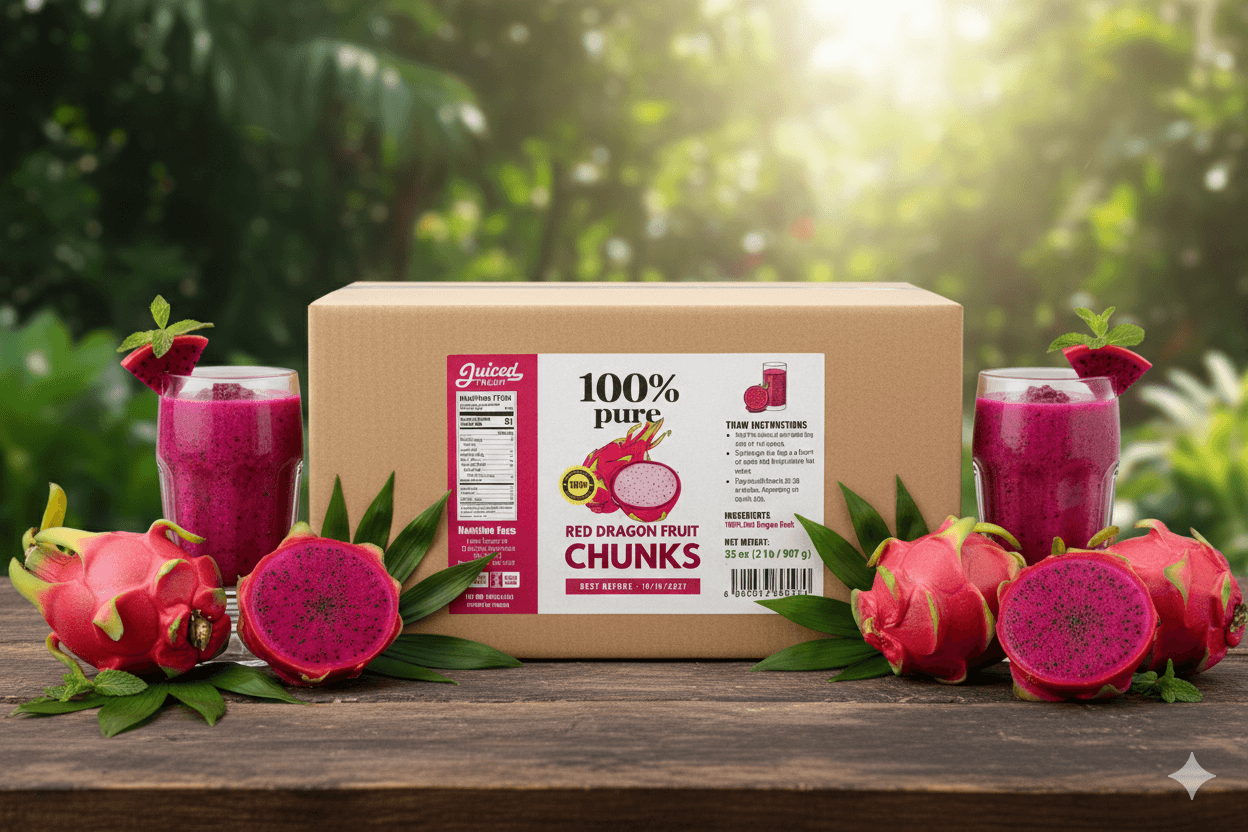
Dragon fruit is the fastest-growing tropical fruit category in American foodservice. The smoothie bowl trend alone created a multi-billion-dollar market that essentially didn't exist 10 years ago. But there's a question operators rarely get a clear answer on: red or white dragon fruit?
The answer matters for both customer experience and unit economics. This is the breakdown we give to juice bar owners, smoothie shops, and dessert kitchens when they ask.
What Dragon Fruit Is, Briefly
Dragon fruit, or pitaya, is the fruit of several cactus species in the Hylocereus and Selenicereus genera. The three commercial varieties:
- White-flesh (Hylocereus undatus): Pink skin, white flesh with black seeds. Mild flavor, low sugar. The most common variety.
- Red-flesh (Hylocereus costaricensis): Pink skin, deep magenta flesh. Sweeter, more intense color and flavor.
- Yellow-flesh (Selenicereus megalanthus): Yellow skin, white flesh. Sweetest of the three, rare in US foodservice.
For most American operators, the real choice is red vs white. Yellow is specialty.
Color: The One You Already Know
The visual difference is dramatic and it's what most customers respond to. White-flesh dragon fruit, blended into a smoothie or bowl, produces a faint pink-white color that photographs as washed-out and reads as "okay but not exciting." Red-flesh produces deep magenta throughout, the color the smoothie bowl trend was built on.
If color matters to your menu (and for smoothie bowls, color is the menu), red is not optional. It's the only choice.
Flavor: More Distinct Than You'd Think
White-flesh dragon fruit has a mild, barely-there flavor. Some operators describe it as "wet," meaning it carries a lot of water and not much taste. Brix typically ranges 8 to 12, so it reads as lightly sweet at best. The flavor profile is gentle kiwi with a hint of pear.
Red-flesh is noticeably sweeter (Brix 11 to 15) and more distinctly tropical. The flavor carries notes of berry and watermelon, with more aromatic depth. In a blind taste test, most people prefer red to white, and the gap is larger than you'd expect.
For a smoothie bowl operator using dragon fruit as a supporting ingredient for color, the flavor difference matters less (banana, strawberry, and coconut are doing the heavy lifting anyway). For a sorbet, panna cotta, or any preparation where dragon fruit is carrying the flavor, red is the only variety that reads as dragon fruit.
Nutritional Profile
Both varieties are genuine superfruits, but red-flesh runs higher on most nutritional metrics:
- Antioxidants: Red contains betacyanins (the pigments responsible for the magenta color), which are strong antioxidants. White-flesh lacks these.
- Vitamin C: Red averages 3-5% higher.
- Iron: Red averages 2x higher, likely due to the betacyanin content.
- Fiber: Similar between varieties.
- Calories: Similar, both around 60 kcal per 100g.
For health-forward positioning (wellness cafés, juice bars marketing on nutritional benefits), the antioxidant story alone makes red the right choice.
Price and Supply
Wholesale pricing varies by region and source, but general trends:
- White dragon fruit is cheaper, usually 20 to 30% less per kilogram than red.
- Fresh dragon fruit (both varieties) is expensive in the US. Frozen is more economically viable for commercial operations.
- Vietnam produces red dragon fruit at commercial scale with the deepest color and cleanest flavor. Latin American red (mostly from Mexico and Nicaragua) is lower quality with less color intensity.
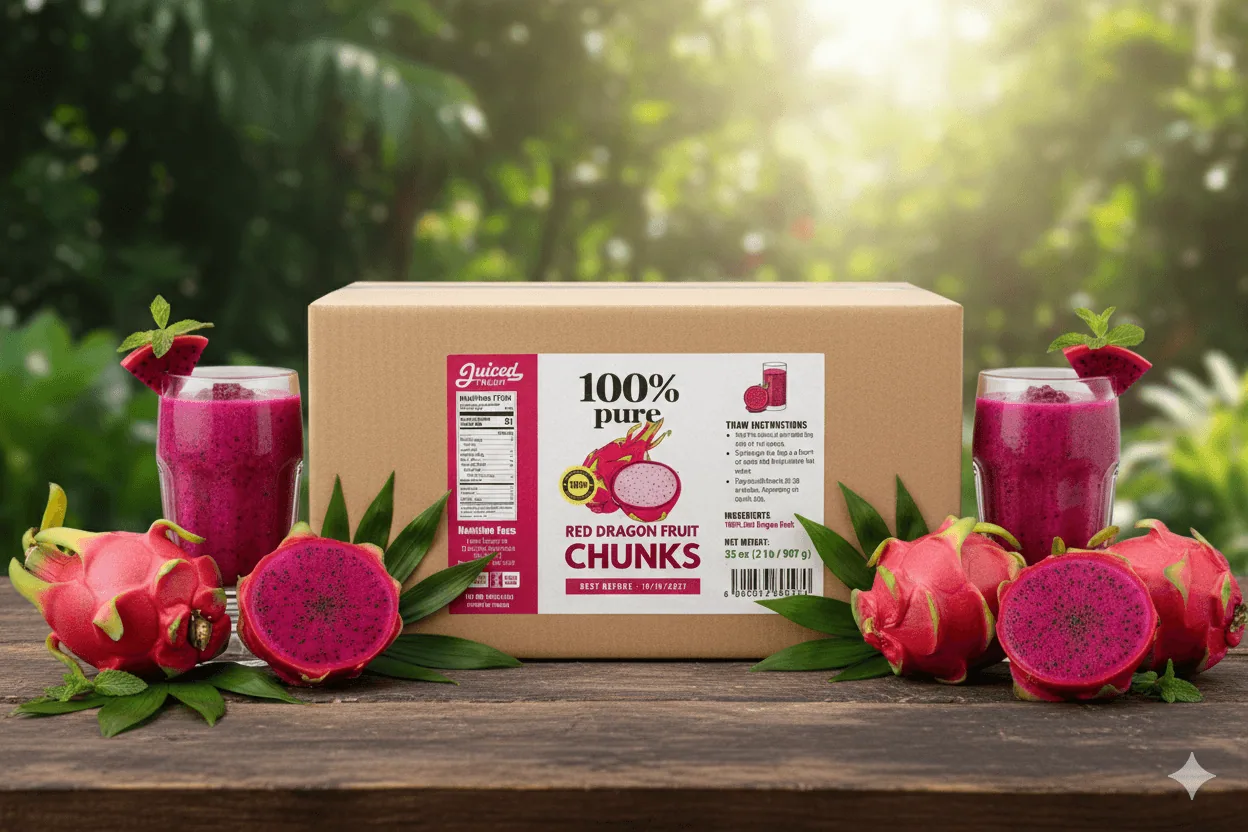
We source red-flesh dragon fruit chunks exclusively from Vietnam, flash-frozen at the farm. 10 kg cases of IQF (individually quick-frozen) chunks work out to significantly lower cost-per-serving than fresh, with none of the spoilage. For standing orders, wholesale pricing is available at case and pallet volume.
Which for Which Use Case
Smoothie bowls and pitaya bowls. Red, always. The color is the product.
Smoothies where dragon fruit is a minor ingredient (under 15% by volume). Either works. Red gives you the pink color as a bonus; white saves money.
Sorbet and frozen desserts. Red. The pigment is stable through freezing and produces a dessert that plates at a color customers remember.
Panna cotta, mousse, parfaits. Red, for the same color reason.
Yogurt parfaits and breakfast bowls. Red for visual impact.
Garnish and plate decoration. White for visual contrast (against dark chocolate, for instance). Red for standalone impact.
Functional and health drinks. Red, for the antioxidant positioning.
Cocktails. Red, for both color and flavor. White doesn't carry enough flavor to register in a spirits-forward drink.
The one category where white actually wins is low-cost smoothie bases where you're using dragon fruit purely for fiber and volume with no color or flavor objective. In that narrow case, white is cheaper and gets the job done.
Common Mistakes
Buying "dragon fruit" from a distributor without specifying variety. You'll almost always get white. If you want red, you have to ask specifically, and many American distributors don't even stock red.
Assuming all red dragon fruit is the same. Vietnamese red pitaya runs consistently sweeter and more vibrantly colored than Latin American red. For menu items where color is the point, origin matters.
Using pre-puréed pitaya instead of chunks. Commercial purée is often made from a mix of varieties and has lost color intensity through processing. IQF chunks let you control texture and preserve the deep color pre-blend.
Thawing before blending. For smoothies and bowls, blend IQF chunks direct from the freezer. Thawing first produces a looser, waterier result.
FAQ
Is yellow dragon fruit worth sourcing?
If you have a strong reason to run three-color dragon fruit (high-end tasting menu, specialty retail), sure. For general foodservice, no. Yellow is rare in the US, expensive, and doesn't deliver enough visual or flavor difference to justify the extra SKU.
Does red dragon fruit stain?
Yes. The betacyanin pigment is strong. Rinse blenders, knives, and silicone immediately after use with cold water. It won't permanently stain stainless or plastic if you clean promptly.
Will my customer's stool turn red?
Yes, if they eat enough of it. Betacyanin passes through the digestive system, occasionally producing pink urine or stool. It's harmless but can be alarming the first time. This is not a customer service issue we can help with beyond reassurance.
How much does a 10 kg case yield for smoothie bowls?
About 280 standard 2-oz bowl portions. At $10-12 per bowl retail, that's roughly $2,800 in gross revenue per case. Ingredient cost typically runs 12-18% depending on your base and toppings.
Published by Juiced Fresh.
Notes from the warehouse, the farm, and the bars we supply. See all Field Notes