Dragon Fruit Profit Margins for Smoothie Bowls and Juice Bars
A 10 kg case of frozen red dragon fruit yields a knowable number of portions, and the margin math is better than most operators expect. Here is the real cost per bowl, per drink, and why frozen chunks beat whole fresh fruit on waste.
Red dragon fruit is one of the few menu items that sells itself on sight. The deep magenta color photographs better than anything else behind the counter, customers order it because of how it looks, and it carries a price most fruit cannot. The question is not whether it draws attention. The question is whether the unit economics hold up once you are buying it every week.
They do, and the math is more forgiving than most operators assume. The trick is buying frozen ready-to-blend chunks instead of whole fresh fruit, because that one decision is what turns a high-spoilage specialty item into a predictable line on your prep sheet.
This is a working breakdown for juice bar and smoothie-bowl operators: portions per case, cost per bowl, cost per drink, and the gross margin you can expect at normal menu prices. All of it is built on a real case spec, not a guess.
The case spec we are working from
The numbers below use Red Dragon Fruit Chunks sold by the 10 kg box. A single case runs about $99. Buy a pallet, which is 120 cases at 17% off before freight, and the per-case cost drops to roughly $82.17. Both numbers matter, so the breakdown shows margin at each.
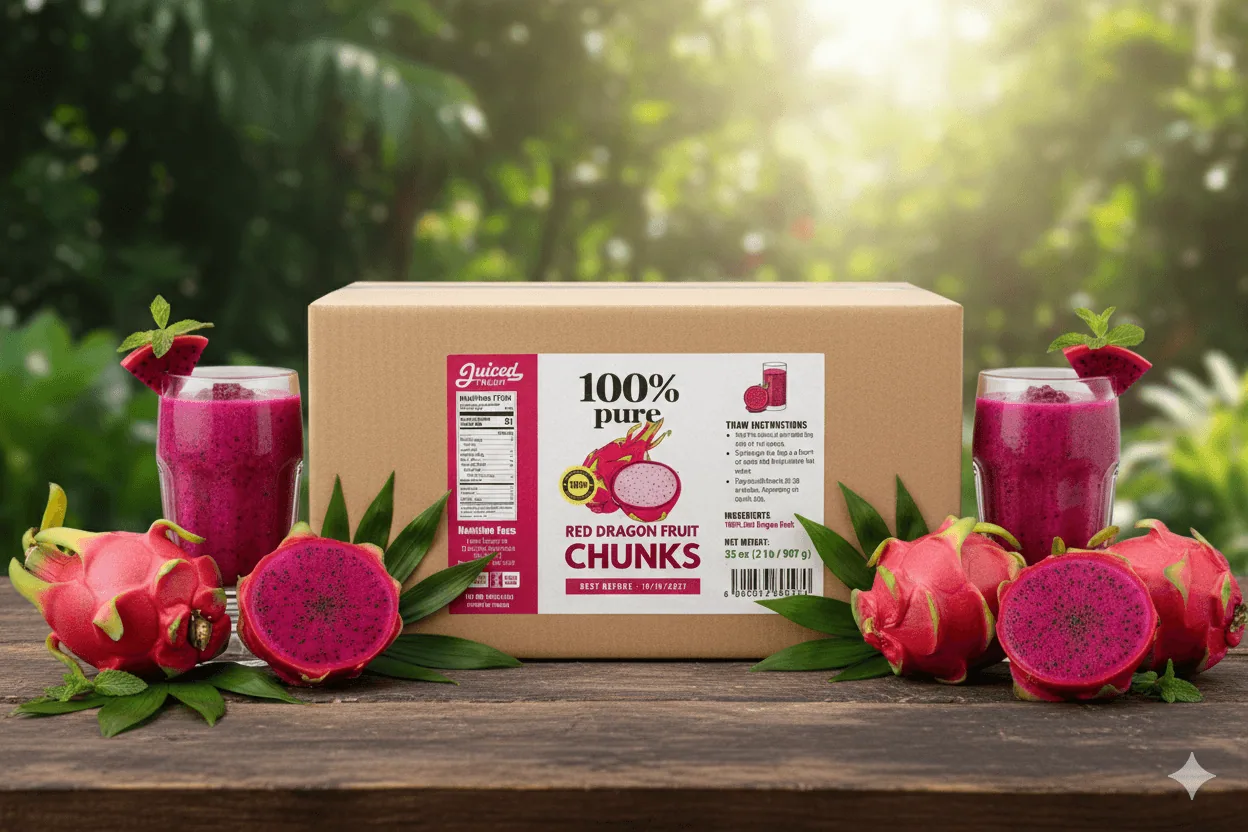
These are frozen red and pink pitaya chunks, flash-frozen within about four hours of harvest. No concentrate, no additives, just fruit cut and frozen at peak. That detail is not marketing. It is the reason the cost per portion is knowable in the first place, because every gram in the box is usable product.
The economics, gram by gram
Start with yield. A 10 kg case is 10,000 grams of edible chunks. There is no peel to discard and no soft fruit to throw out, so your usable yield is the full case weight. That alone separates frozen chunks from whole fresh fruit, where a meaningful share of every piece you buy ends up in the trash.
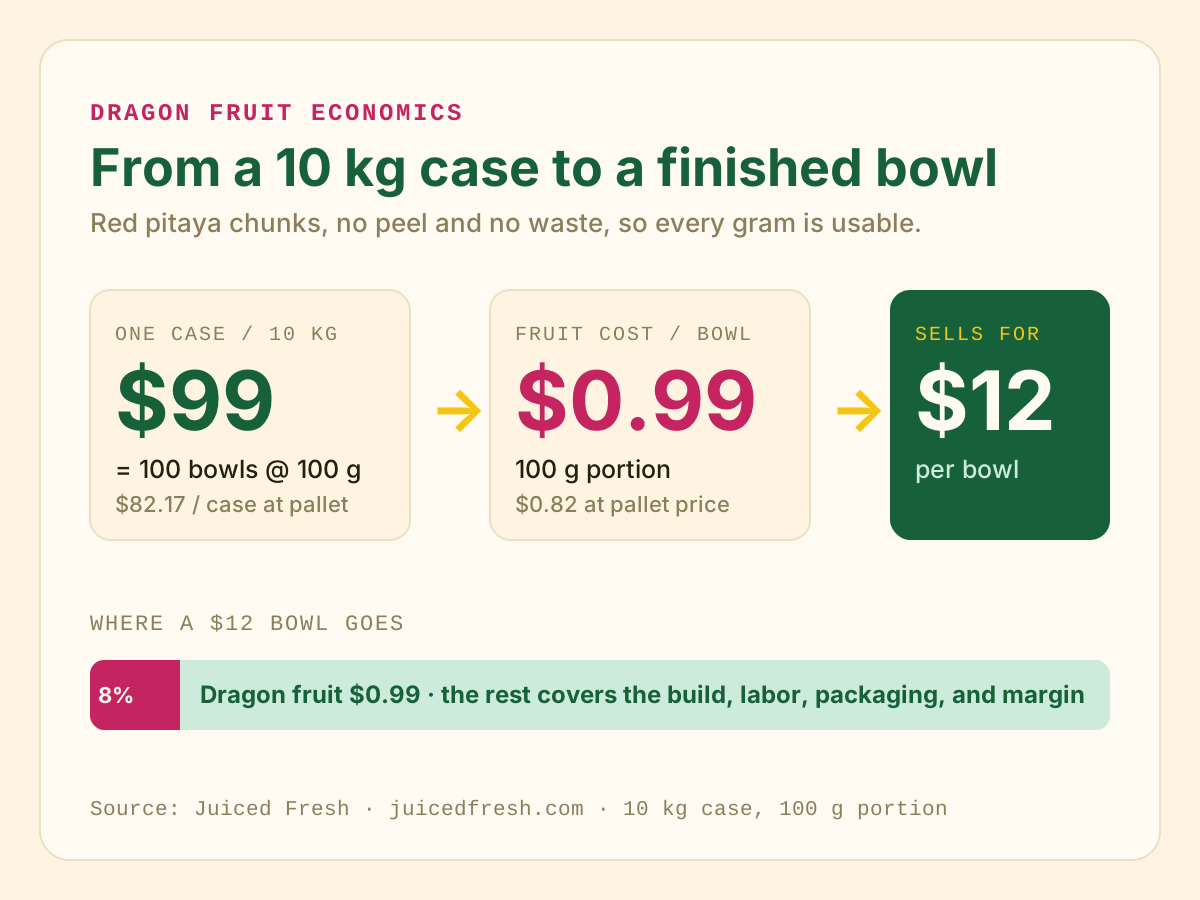
At a single-case cost of $99, your raw fruit cost is about $0.0099 per gram, call it one cent. On a pallet at $82.17 per case, it drops to roughly $0.0082 per gram. From there the per-portion cost is simple arithmetic.
Here is what that looks like at sensible portion sizes:
- Smoothie bowl base at 100 g of dragon fruit: about $0.99 per bowl at case price, about $0.82 at pallet price. A 10 kg case yields 100 bowls.
- Lighter bowl or blended-in portion at 80 g: about $0.79 per bowl at case price, about $0.66 at pallet price. The case yields 125 portions.
- Generous hero bowl at 120 g: about $1.19 per bowl at case price, about $0.99 at pallet price. The case yields roughly 83 bowls.
- Drink pour at 60 g for a smoothie or blended juice: about $0.59 at case price, about $0.49 at pallet price. The case yields around 166 servings.
Now lay menu price over it. Smoothie bowls commonly sell for $9 to $14. Take a 100 g dragon fruit bowl priced at $12. The dragon fruit itself costs you about a dollar, or roughly 8% of the menu price as a single ingredient. Even after you add the rest of the build, banana, liquid base, toppings, and packaging, dragon fruit is rarely the line that threatens your food cost. It is the line that lets you charge more.
At a dollar of dragon fruit in a twelve-dollar bowl, the color is doing far more for the ticket than it costs.
For a blended drink, the story is similar. A 60 g pour at about 59 cents inside a $8 to $10 smoothie keeps that ingredient under 8% of the price while giving the cup a color and flavor that plain berry blends cannot match. If you are building a dragon fruit for juice bars program around blended drinks and bowls together, the same case feeds both, which keeps your inventory simple.
The honest caveat: these figures are the dragon fruit cost only. Your true food cost includes everything else in the build, plus labor and freight. But that is exactly the point. When a signature ingredient lands near one dollar per portion against a double-digit menu price, it gives you room everywhere else. That is why dragon fruit pencils out as a margin driver rather than a margin drain.
Why frozen single-origin keeps the math honest
The case math above only holds if every case behaves like the last one. That is the real argument for frozen single-origin fruit over whole fresh.
Whole fresh dragon fruit fights you on three fronts. It spoils fast once ripe, so you are forced to buy in rhythm with how quickly it turns rather than how much you sell. It has to be cut and peeled, which is labor and waste on every piece. And its price and quality swing hard with season and import conditions, so the bowl that costs you a dollar in fruit this month can cost noticeably more next month, or show up underripe and pale.
Frozen chunks remove all three problems. You portion only what you sell, so a slow Tuesday costs you nothing in spoilage. There is no prep beyond scooping. And because this fruit is single-origin from Vietnam's Mekong Delta, from Ben Tre and Long An, and frozen at -35C within hours of harvest, the color and sugar are locked at peak. The case you open in January performs like the case you open in July. With up to a two-year frozen shelf life, you can buy at pallet pricing without gambling on whether you will use it in time.
Color is part of the product you are selling, and frozen protects it. Red pitaya frozen at the right moment holds that saturated magenta. Fruit that ripened in transit, or sat in a cooler too long, fades toward dull pink, and a faded bowl is a bowl that does not get photographed or reordered. Consistency here is not a nicety. It is the difference between a hero item and an item customers stop trusting. This is the case for working with a dedicated frozen dragon fruit wholesale supplier rather than chasing fresh produce availability week to week.
On the menu: builds, portions, and blending
Here is how the case translates into things customers actually order.
The classic pitaya bowl. Blend 100 g frozen dragon fruit chunks with half a frozen banana and just enough liquid, around 60 to 90 ml of coconut water or juice, to get a thick, scoopable consistency. You want it firm enough to hold a spoon upright, not pourable. Pour into a bowl and finish with granola, fresh fruit, coconut flakes, and a drizzle. That deep magenta base is the whole reason this bowl outsells a standard berry bowl, and at about one dollar in dragon fruit it carries strong margin at a $12 to $14 price.
The color-layer trick. You do not always need a full dragon fruit base. Use 50 to 60 g blended into an existing bowl recipe purely to drive the color, and the case stretches to well over 150 portions. This is the cheapest way to upgrade a tired menu photo without rebuilding the whole recipe.
The blended drink. For a smoothie, drop 60 g of chunks into the blender with your other fruit and base. It blends smooth with no stringiness and tints the entire cup pink. Dragon fruit is mild and lightly sweet, so it adds color and body without overpowering banana, berry, or citrus. For a dragon fruit for smoothie bowls and drinks lineup, this versatility is what lets one SKU earn its place across the board.
A few blending notes worth keeping on the prep card:
- Blend from frozen. The chunks are the structure of a thick bowl, so do not thaw them first. Add liquid slowly and stop as soon as it comes together.
- Less liquid than you think. The most common mistake is a soupy bowl. Start dry, scrape down, and add liquid by the splash.
- Pair with frozen banana for body. Banana adds creaminess and natural sweetness and helps the base hold its shape for plating.
- Keep cases sealed in the freezer until service. Portion straight from frozen and reseal. Refreezing thawed product is what costs you the color.
How much should I order to start?
Start with a few cases to test the item, then move to pallet pricing once it is on the menu and selling. Cases ship online through DeliveredCold; pallets and full containers are quoted over WhatsApp, where you usually get a reply in minutes. One 10 kg case is 100 bowls at a 100 g portion, which is enough to run a real trial and see your actual reorder pace before committing to volume.
Does frozen dragon fruit work for smoothie bowls?
Yes, and for bowls specifically it is better than fresh. The chunks blend from frozen into the thick, scoopable base a proper pitaya bowl needs, and you portion only what you sell so there is no spoilage on slow days. Flash-frozen red pitaya also holds its deep color far better than fresh fruit that has spent days in transit.
What is the gross margin on a dragon fruit smoothie bowl?
At about one dollar of dragon fruit in a $12 bowl, that ingredient is roughly 8% of the menu price. Your full food cost includes the rest of the build, packaging, and freight, but dragon fruit lands well within a healthy margin and typically raises the price you can charge rather than threatening your cost. The exact gross margin depends on your other ingredients and your local pricing.
How many smoothie bowls does a case of dragon fruit make?
A 10 kg case is 10,000 grams of usable chunks with no peel or waste. At a 100 g portion that is 100 bowls per case. At an 80 g portion you get 125, and a 60 g drink pour yields around 166 servings.
Red dragon fruit earns its spot on the menu because it commands a premium price while costing about a dollar a portion, and frozen single-origin chunks are what make that margin reliable week after week. See full specs and order cases on the Red Dragon Fruit Chunks page, review wholesale and pallet pricing to lock in the 17% pallet discount, or browse products to round out your bar. As a US-based dragon fruit supplier shipping frozen from Austin in 2 to 5 days nationwide, we can quote a pallet or container over WhatsApp, usually with a reply in minutes.
Published by Juiced Fresh.
Notes from the warehouse, the farm, and the bars we supply. See all Field Notes